
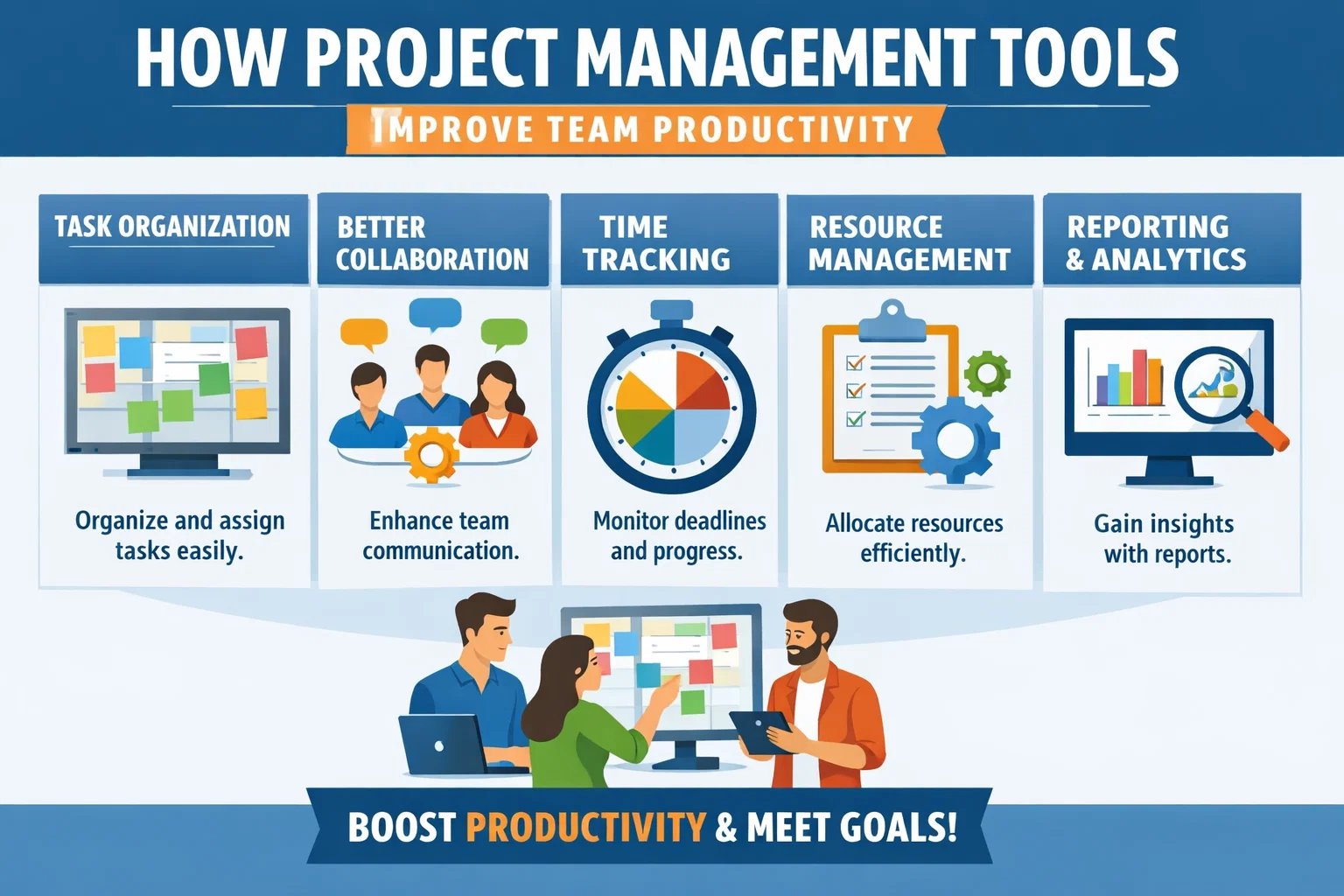
In today’s competitive global business environment, team productivity is no longer a luxury—it is a necessity. Companies operating in Tier-1 countries such as the United States, United Kingdom, Canada, Australia, and parts of Europe rely heavily on project management tools to maintain efficiency, accountability, and growth.
This in-depth guide explains how project management tools improve team productivity, why they are essential for modern businesses, and how organizations can leverage them to achieve measurable performance gains.
Why Productivity Is a Critical Business Metric
Productivity directly impacts:
- Revenue growth
- Operational costs
- Employee satisfaction
- Customer experience
In high-cost Tier-1 markets, even small productivity improvements can translate into significant financial returns. This is why project management productivity software has become a high-value investment category.
The Productivity Challenges Modern Teams Face
Before understanding how project management tools help, it’s important to recognize common productivity blockers:
- Unclear goals and priorities
- Poor communication
- Missed deadlines
- Overloaded team members
- Lack of performance visibility
Project management tools are specifically designed to solve these problems.
How Project Management Tools Increase Team Productivity
1. Clear Task Ownership and Accountability
One of the biggest productivity killers is confusion over responsibility. Project management tools assign clear ownership to every task.
- No ambiguity about responsibility
- Improved accountability
- Faster task completion
This clarity alone can significantly boost productivity.
2. Centralized Work Management
Instead of scattered emails, spreadsheets, and chats, project management tools centralize all work in one place.
- Instant access to tasks, files, and updates
- Reduced time spent searching for information
- A single reliable source of truth
This centralization improves efficiency across departments.
3. Improved Collaboration and Communication
Collaboration features are a core driver of productivity. Modern tools provide:
- Task-level comments
- Mentions and notifications
- File sharing with version control
This reduces unnecessary meetings and email overload.
4. Visual Workflow Management
| Visual Tool | Purpose | Productivity Impact |
|---|---|---|
| Kanban Boards | Track task flow | Faster execution |
| Gantt Charts | Plan timelines | Reduced delays |
| Dashboards | Monitor progress | Better decisions |
Visual management enables teams to understand progress instantly and respond quickly.
5. Better Time Management and Focus
Project management tools help teams focus on high-priority work through:
- Task prioritization
- Due-date reminders
- Built-in time tracking
This reduces distractions and improves daily productivity.
6. Resource and Workload Optimization
Overworked teams are unproductive teams. Workload management allows managers to:
- Balance tasks evenly
- Prevent burnout
- Improve long-term performance
This capability is especially valuable for agencies and enterprise organizations.
7. Automation of Repetitive Tasks
Automation is a major productivity accelerator. Project management tools automate:
- Status updates
- Recurring tasks
- Notifications and reminders
This saves time and reduces human error.
8. Real-Time Reporting and Insights
Data-driven teams outperform guess-based teams. Reporting features provide insights into:
- Team performance
- Project health
- Bottlenecks and risks
Managers can act quickly to maintain productivity.
9. Support for Remote and Hybrid Teams
Remote work is now standard across Tier-1 markets. Project management tools enable:
- Seamless remote collaboration
- Time-zone friendly workflows
- Equal visibility for all team members
This keeps distributed teams aligned and productive.
10. Integration with Business Software
Top productivity platforms integrate with:
- CRM systems
- Accounting software
- Email and chat platforms
- Cloud storage services
Integrations eliminate duplicate work and streamline operations.
Enterprise Productivity Gains from Project Management Tools
Large organizations benefit from:
- Portfolio-level visibility
- Standardized workflows
- Scalable productivity systems
These tools enable consistent performance across departments and regions.
ROI of Project Management Productivity Software
Businesses using project management tools commonly report:
- Faster project delivery
- Lower operational costs
- Higher employee engagement
- Improved client satisfaction
This makes project management software one of the highest-ROI SaaS investments available.
Future Trends in Productivity Tools
The future of project management productivity includes:
- AI-driven task prioritization
- Predictive workload planning
- Smart productivity analytics
These innovations will further enhance efficiency and decision-making.
Final Thoughts
Project management tools dramatically improve team productivity by creating clarity, reducing friction, and enabling smarter work. For businesses operating in high-cost, high-competition Tier-1 markets, these tools are no longer optional—they are essential.
Investing in the right project management productivity software is a strategic decision that delivers long-term operational efficiency, stronger collaboration, and sustainable business success.