
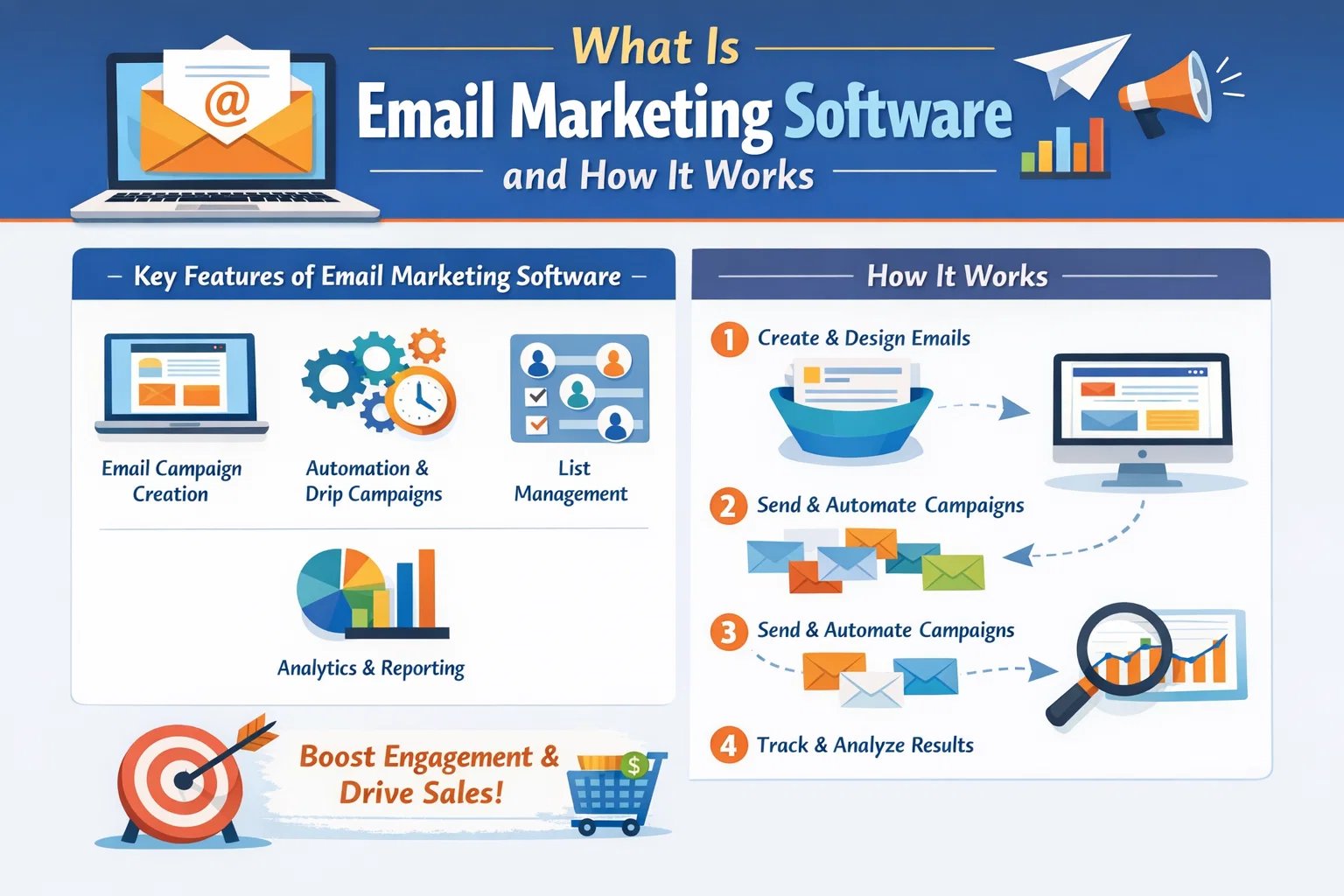
Email marketing software has become one of the most powerful and cost-effective digital marketing tools for businesses worldwide. Despite the rise of social media, paid advertising, and influencer marketing, email marketing continues to deliver one of the highest returns on investment—especially in Tier-1 countries such as the United States, United Kingdom, Canada, and Australia.
Modern email marketing platforms go far beyond sending bulk messages. They combine automation, personalization, analytics, CRM integration, and AI-driven optimization to help businesses nurture leads, increase conversions, and retain customers at scale.
What Is Email Marketing Software?
Email marketing software is a digital platform that enables businesses to create, manage, automate, and analyze email campaigns sent to subscribers, prospects, and customers. Most solutions are delivered as SaaS products and are widely used by startups, e-commerce brands, SaaS companies, agencies, and enterprises.
The core objective is simple: deliver the right message to the right audience at the right time—automatically.
Why Email Marketing Software Is Critical for Businesses
- Direct communication with customers
- High marketing ROI
- Full ownership of audience data
- Advanced personalization and segmentation
- Measurable analytics and performance tracking
How Email Marketing Software Works
1. Contact & Subscriber Management
Email platforms organize subscriber information such as email address, name, demographics, behavior, purchase history, and engagement metrics. Contacts can be collected via signup forms, landing pages, CRM imports, or APIs.
2. Email Campaign Creation
Most tools provide drag-and-drop builders, responsive templates, and HTML editors that allow marketers to design professional emails without coding knowledge. Emails can include CTAs, images, dynamic content, and personalization tokens.
3. Segmentation & Targeting
Segmentation divides subscribers into meaningful groups based on behavior, lifecycle stage, or demographics—dramatically improving open rates, click-through rates, and conversions.
4. Automation & Workflows
Automation enables triggered email sequences such as welcome emails, onboarding flows, abandoned cart reminders, and re-engagement campaigns—saving time while increasing revenue.
5. Email Delivery Infrastructure
Professional platforms manage sending servers, IP reputation, authentication protocols (SPF, DKIM, DMARC), and compliance rules to ensure strong inbox deliverability.
6. Analytics & Performance Tracking
Marketers gain real-time insights into open rates, clicks, conversions, bounce rates, and revenue attribution—allowing continuous optimization.
Key Features of Email Marketing Software
- Email automation workflows
- Drag-and-drop email builder
- Advanced audience segmentation
- A/B testing capabilities
- CRM and SaaS integrations
- Transactional email support
- AI-powered subject line optimization
- Compliance and consent management
Email Marketing Software vs Traditional Email Tools
| Feature | Email Marketing Software | Traditional Email |
|---|---|---|
| Automation | Yes | No |
| Analytics | Advanced | Limited |
| Deliverability Optimization | High | Low |
| Personalization | Dynamic | Manual |
| Scalability | Enterprise-ready | Not scalable |
Types of Email Marketing Software
- Email Campaign Platforms – newsletters, promotions, announcements
- Marketing Automation Platforms – multi-channel workflows, CRM, lead scoring
- Transactional Email Software – receipts, password resets, order confirmations
- Enterprise Solutions – advanced security, compliance, and scalability
Common Use Cases
- Lead nurturing campaigns
- E-commerce abandoned cart recovery
- SaaS onboarding sequences
- Customer retention and upselling
- Event promotions and reminders
- Transactional notifications
Benefits of Email Marketing Software
- Higher engagement and loyalty
- Lower customer acquisition costs
- Improved conversion rates
- Scalable marketing automation
- Actionable reporting and insights
Email Marketing Compliance & Security
Leading platforms comply with global regulations such as GDPR, CAN-SPAM, and CASL. Built-in features include consent tracking, unsubscribe management, encryption, and secure data handling to protect user privacy.
How AI Is Transforming Email Marketing
Artificial intelligence enhances segmentation, predicts optimal send times, personalizes content recommendations, and improves subject lines—resulting in higher engagement and revenue.
Choosing the Right Email Marketing Software
- Scalability and pricing model
- Automation depth
- CRM and SaaS integrations
- Deliverability reputation
- Security and compliance standards
Future of Email Marketing Software
The future lies in AI-driven personalization, real-time customer journey orchestration, and deep integration with CRM, analytics, and revenue attribution systems—making email an even more powerful growth channel.
Conclusion
Email marketing software remains one of the most reliable and profitable digital marketing investments. With automation, analytics, and AI optimization, modern platforms enable businesses to build stronger relationships, increase conversions, and scale efficiently.
In today’s competitive digital landscape, leveraging the right email marketing software is not optional—it is essential for sustainable growth.